The winds are light today, but no flights again do to the sustained gray. There is little chance that today will be the day that Andersen Creek melts... so I will take a hike today after a few hours on my dissertation. I sit comfortably inside Lake Hoare Camp now. Looking out upon this gray day with anticipation.
 The glaciers of the dry valleys are unique, they are not experiencing the rapid retreat of their temperate and tropical counterparts. The rest of the mountain glaciers of the world have accelerated in their demise, especially it seems within the last decade (from what you can see from the photographs and moraines (rocks left by receding glaciers) left identifying glaciers used to be). What used to be snow is now falling as rain at higher and higher altitudes. This is a big concern to people reliant on glacier melt for drinking water, crops and energy. Especially areas with dry summers and little other water. (Snowpack is similarly important).
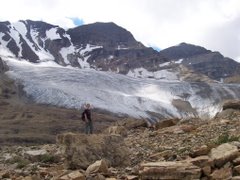
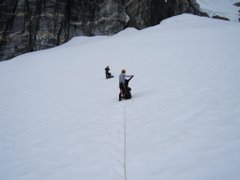
 Above and below are shots of the Canada Glacier.
 While I wrote, the Frankenberg Fish went back to the Suess Glacier for a glamor shot. I realize that I am not writing this for kids (but hope the pictures entertain).
 In the meantime the Flats found a dry patch and a mummified seal that had lost its way back to the Ross Sea and wandered inland instead. They were not sure what to make of this poor creature.
 It feels even more remote here with snow because all Helicopter traffic stops (not that there is a lot, but 2 or 3 a day is a beacon connecting us with McMurdo).

 (The pocked ice in the background is Lake Hoare, the foreground is Canada Glacier looking toward Suess Glacier.)
 (Here is another shot of our descent down the glacier to Lake Hoare.)
 Lake Hoare ice sprouts into ice gardens, these will melt away later with the summer thaw, crunching under our boots.
 Canada Glacier has a beach, formed not by breaking waves, but by the melt pools draining from the glacier. Sediment blown onto the glacier comes down, most of the fines have been dissolved leaving mostly sand.
 (our ascent)
 This is the inside of a channel on the Canada Glacier (supraglacial channel).
 (I had to snake on my stomach through most of the channel, but was relieved to find this spot to take a breath).
 Lee is examining an ice crystal from the channel that was stuck on my cap.
 Flat Stan sprung from my pocket, wondering if he had spotted other penguins. (The other flats will help me in the lab tonight).
 More from the channels (above and below)

 Tonight I will sample Anderson Creek (the stream running against Canada Glacier) and I am camp house mouse, which means that I am responsible for emptying grey water and cleaning the dishes (we all help each other out with these tasks)... It is also shower day (a bucket of glacier melt warmed by a stove funneled through a plastic hose).
 Along the way we came across 3 Adelie penguins huddled against the 20-30 knot gusts that bombarded us (the flats had to stay in my pocket, or risk being whisked away into the Ross Sea). They had a nice time riding in the Delta and meeting new people.
 Inside tins of food and coffee and bunks smaller than children's beds for grown men to curl up in...
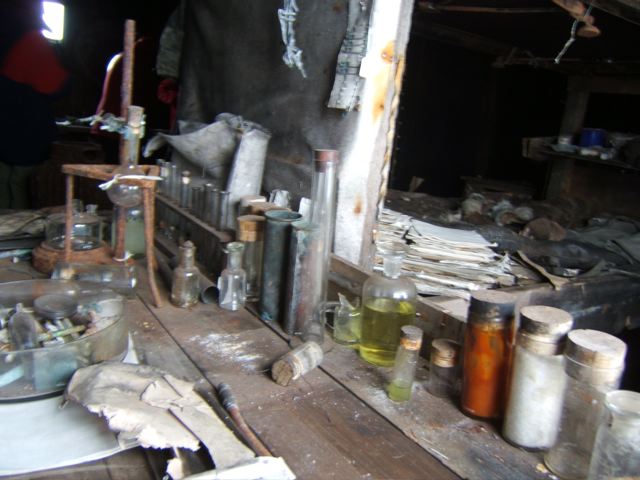
 A chemistry lab that likely rivaled any other built during its time.
 And the Ross Sea gritty and barely catching blowing snow, making walking slippery without thick treads and dedication. Can you imagine looking across this vast landscape and deciding to walk South, further into the blasting wind, further into the freezer?
 On the ride home, an astrophysicist from Caltech who had wintered-over at the Pole detailed how they are using microwave telescopes to view the farthest margins of our universe. Our universe is surprisingly aged-constrained at around 13.7 Billion years old, with this new telescope able to reach out to when our universe was a nascent 300 million years old. At this time our universe was opaque. So hot that electrons scattered, unable to join with protons and neutrons to form even the most basic elements, light did not exist as we know it now. Today, in the same breath as Scott, the universe is bright. Antarctica is a blinding cold mesmerizing place, where it seems that little remains of our Universe's fiery origins.

 The animals had a better look at the inside...
 Our shadows were long in the circling sun.
 But when I got up to stretch my legs a little, the quickly made themselves comfortable in Big Red (the proper name for a downy parka).
 So I enticed them with a tour of the front of the plane, including a quick hello to the flight staff.
 Here is a better view of our luxury seating, coupled with the sound of massive engines muted only by yellow foam and dreams of our destination.
 We all had a look out the window, waiting for the first sign of ice.
 After I get some field prep done, I'll go hike around and take some more pictures of McMurdo, I will be here for another 3 days getting things together and attending a snow school refresher course (this is a survival course to prepare all people who go into the field for the harsh conditions we may face).
 However, the Frankenburg Fish was a bit tired from the lack of water to sleep in on the plane...
 While the Gator and Fish took care of things at the B&B, Flat Stan and I took a nice walk through Christchurch. (We stopped at the Botanical Garden.)
 & the Arts Centre

 Its the week before I get on the plane to ChCh (better known as Christchurch New Zealand), and I still haven't packed, just piled my stuff into things to take to the field (not quite like piling rope to catch a Helo, above). Piles include papers, books and other reading material that might help me make progress writing my dissertation. That's right, I am going to do some writing while I am in Antarctica. But, not at the expense of good field work or beautiful days- I see the end of the dissertation tunnel and may feel like writing some day in the cookshack when my tent is battered by katabatics...