Monday, December 03, 2007

Preparation and Dissertation

I'm posting a few more pics from yesterday (Monday) and Sunday... today I spent much of the day organizing future sampling trips and equipment. Working on the glacier requires coordinating schedules. The glaciers of the dry valleys are unique, they are not experiencing the rapid retreat of their temperate and tropical counterparts. The rest of the mountain glaciers of the world have accelerated in their demise, especially it seems within the last decade (from what you can see from the photographs and moraines (rocks left by receding glaciers) left identifying glaciers used to be). What used to be snow is now falling as rain at higher and higher altitudes. This is a big concern to people reliant on glacier melt for drinking water, crops and energy. Especially areas with dry summers and little other water. (Snowpack is similarly important).

Why are the dry valley glaciers an exception? Antarctica is isolated from the rest of the world with circumpolar winds and a huge ozone hole, that may or may not be healing itself. (These are among the many hypotheses being explored).

I do wonder if the channels we crawled in the last few days are indicative of change to come. I don't remember them being so incised 6 years ago. The surface is very dynamic, but it almost looks as though lower on the glacier the channels are able to penetrate deeper into the icy surface. The trapped sediment in the middle of the channel walls is at approximately the depth of the channels the first time I visited... (Could it be that the channels are 2 times deeper???)
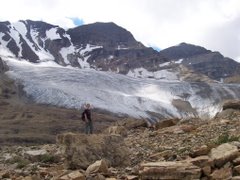
Above and below are shots of the Canada Glacier.

While I wrote, the Frankenberg Fish went back to the Suess Glacier for a glamor shot. I realize that I am not writing this for kids (but hope the pictures entertain).

Snow at Lake Hoare Camp

Just when it looked like the streams would be running, it got colder beginning yesterday afternoon. Gusts turned to flurries and soon no water was left unfrozen. The sun has just come out again (so I'm hoping to sample streams tomorrow-my fingers are crossed).
In the meantime the Flats found a dry patch and a mummified seal that had lost its way back to the Ross Sea and wandered inland instead. They were not sure what to make of this poor creature.
It feels even more remote here with snow because all Helicopter traffic stops (not that there is a lot, but 2 or 3 a day is a beacon connecting us with McMurdo).


I've been working on my dissertation every day (its amazing to be able to walk out the door into the vast landscape, the salty soil scouring at rocks, and to come inside and make a cup of tea and write.... ) My days are very productive here with all of this encouraging light.

Saturday, December 01, 2007

Colors of Canada Glacier


Today we explored the Canada Glacier- little water was flowing, so I was unable to sample, but it looks like the stream adjacent to camp is starting to trickle revitalizing the camp with its gargling voice. (Above is the lower glacier)
(The pocked ice in the background is Lake Hoare, the foreground is Canada Glacier looking toward Suess Glacier.)
(Here is another shot of our descent down the glacier to Lake Hoare.)

Lake Hoare ice sprouts into ice gardens, these will melt away later with the summer thaw, crunching under our boots.
Canada Glacier has a beach, formed not by breaking waves, but by the melt pools draining from the glacier. Sediment blown onto the glacier comes down, most of the fines have been dissolved leaving mostly sand.
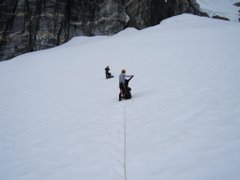
(our ascent)

This is the inside of a channel on the Canada Glacier (supraglacial channel).
(I had to snake on my stomach through most of the channel, but was relieved to find this spot to take a breath).
Lee is examining an ice crystal from the channel that was stuck on my cap.
Flat Stan sprung from my pocket, wondering if he had spotted other penguins. (The other flats will help me in the lab tonight).
More from the channels (above and below)


Tonight I will sample Anderson Creek (the stream running against Canada Glacier) and I am camp house mouse, which means that I am responsible for emptying grey water and cleaning the dishes (we all help each other out with these tasks)... It is also shower day (a bucket of glacier melt warmed by a stove funneled through a plastic hose).

Friday, November 30, 2007

The Universe Was Opaque

A group of ten of us took a Delta (a big red breadtruck with tractor wheels) out to Cape Evans to explore Scott's Terra Nova Hut- where some of his men spent 2 years of their lives surviving off palatable meals of seals and penguin (and many supplies brought from home).
Their home was cold and harsh, with no McMurdo Dorms to seek refuge in, and winter's never-ending howling darkness challenged their mental and physical capabilities.Along the way we came across 3 Adelie penguins huddled against the 20-30 knot gusts that bombarded us (the flats had to stay in my pocket, or risk being whisked away into the Ross Sea). They had a nice time riding in the Delta and meeting new people.

The hut was built in New Zealand and reassembled in 2 weeks at Cape Evans...Inside tins of food and coffee and bunks smaller than children's beds for grown men to curl up in...
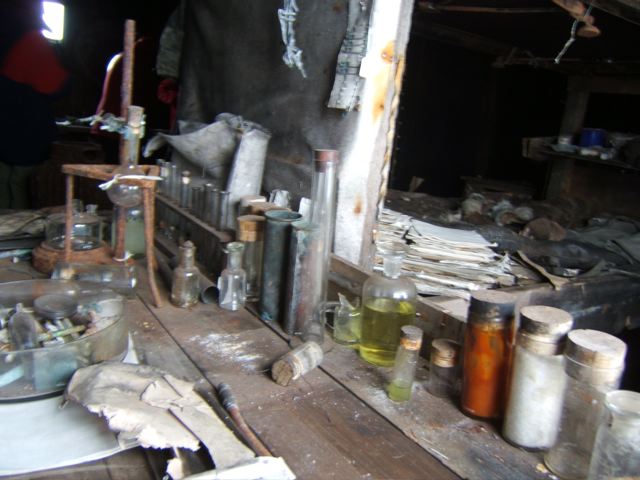
A chemistry lab that likely rivaled any other built during its time.

And the Ross Sea gritty and barely catching blowing snow, making walking slippery without thick treads and dedication. Can you imagine looking across this vast landscape and deciding to walk South, further into the blasting wind, further into the freezer?
On the ride home, an astrophysicist from Caltech who had wintered-over at the Pole detailed how they are using microwave telescopes to view the farthest margins of our universe. Our universe is surprisingly aged-constrained at around 13.7 Billion years old, with this new telescope able to reach out to when our universe was a nascent 300 million years old. At this time our universe was opaque. So hot that electrons scattered, unable to join with protons and neutrons to form even the most basic elements, light did not exist as we know it now. Today, in the same breath as Scott, the universe is bright. Antarctica is a blinding cold mesmerizing place, where it seems that little remains of our Universe's fiery origins.

Wednesday, November 28, 2007

Memories from a different life

A short walk from McMurdo Station down to Hut Point will wake a scientist from the laboratory spell that sets in under fluorescent lighting and well-aligned bottles and return them to a time before cell phones and wireless connections.

Our first glimpse of the Hut that Scott and his crew established over a century ago.

The animals had a better look at the inside...


Our shadows were long in the circling sun.

Also,there are many others from OSU here... Kathy Welch (I have a link to her blog on the sidebar) and Dr. Peter Webb, Katie Johnson, and Cristina Milan---(part of the 200+ Andrill crew drilling a long, long sediment core to explore the climate history of the distant past.)
I've been running into folks left and right in the galley, coffee house, and lab....

Tuesday, November 27, 2007

Southbound

On the way to Antarctica, I ran into Dr. Kathy Sullivan, the first Director for the new Ohio State University, Battelle Center for Mathematics and Science Education Policy at the John Glenn School of Public Affairs. (She has previously been the director for COSI, our excellent science education museum in Columbus). She is part of a Distinguished Visitors tour of Antarctica. Also here from OSU, is Dr. David Elliot, Dr. Larry Krissek, and Dr. Matt Saltzman and Jeremy Gouldey- all affiliated with the School of Earth Sciences. OSU is well represented.

On the C-17 here (a 5 hour flight from Christchurch to McMurdo Station, Antarctica) the flats made themselves comfortable on the cargo crate in front of me...
But when I got up to stretch my legs a little, the quickly made themselves comfortable in Big Red (the proper name for a downy parka).
So I enticed them with a tour of the front of the plane, including a quick hello to the flight staff.
Here is a better view of our luxury seating, coupled with the sound of massive engines muted only by yellow foam and dreams of our destination.
We all had a look out the window, waiting for the first sign of ice.
After I get some field prep done, I'll go hike around and take some more pictures of McMurdo, I will be here for another 3 days getting things together and attending a snow school refresher course (this is a survival course to prepare all people who go into the field for the harsh conditions we may face).

Good times in Christchurch

I made it to Christchurch, New Zealand on Sunday. You gain almost a day (18 hours) crossing the International Dateline and it takes about 28 hours in the plane, or at the airport to make it to Christchurch from Columbus, Ohio. Once you land, the smell of flowers and overwhelms the plane stink that coats your skin and teeth.

I ran into one person I knew in the airport, Lee, another student working in the McMurdo Dry Valleys with the Long Term Ecological Research Program. On the plane I sat next to another Antarctic-bound woman on the plane (she slept blissfully for the 11 hour LAX to Auckland Leg, while I scratched my eyes into half-sleep on foreign flicks.) You can now zone out the movie of your choice on the plane, Now, I am well-rested (and will post next on the trip to the ice).

The flat characters were particularly helpful, helping me get gear organized at the Bed & Breakfast.
However, the Frankenburg Fish was a bit tired from the lack of water to sleep in on the plane...
While the Gator and Fish took care of things at the B&B, Flat Stan and I took a nice walk through Christchurch. (We stopped at the Botanical Garden.)
& the Arts Centre

We also managed to find the only Texan Restaurant in Christchurch, the Adobe Grille, equipped with a fire in the center of the table (We ate there with 2 other south bound travelers).

Thursday, November 15, 2007

Haven't packed yet, still making piles

Its the week before I get on the plane to ChCh (better known as Christchurch New Zealand), and I still haven't packed, just piled my stuff into things to take to the field (not quite like piling rope to catch a Helo, above). Piles include papers, books and other reading material that might help me make progress writing my dissertation. That's right, I am going to do some writing while I am in Antarctica. But, not at the expense of good field work or beautiful days- I see the end of the dissertation tunnel and may feel like writing some day in the cookshack when my tent is battered by katabatics...


My piles are two now: one Antarctic, one Kilimanjaro... and I'm not even sure that the second pile will be used yet, I am still keeping my fingers crossed that all the permits, etc. work out. Becki and I were just talking about all the non-science that goes on before science can occur.

What great fortune to be able return to the Dry Valleys. I've never been there for Christmas, this will be an earlier trip than my previous 2... and the landscape changes so much with the onset of melt. I saw Ann Curry from the Today show huddling next to the Canada Glacier at my/our field camp and it looked so bleak and white. I am taking video this season- to capture the scale of it all... you can hear the melt streams running next to your tent and wake to something bigger than you believed possible, something quite close to paradise.

Sunday, October 14, 2007

adventures ahead

(Banff pictured- a lovely U shaped valley)
In just over a month I will be in the field... first the McMurdo Dry Valleys, second Mount Kilimanjaro. Preparing for these trips is a true test of my organizational skills. I have bags of bottles and gear slowing amalgamating behind my desk and in the lab our spare closet upstairs...rolling beneath my feet, squishing into corners.

I count my great fortune that I am a scientist. Although I like a physical challenge, I am especially invested in the mental challenge- the awe of discovery! And, I have superb mentors- I can't say enough about the advantages of working with the NSF McMurdo Long Term Ecological Research Program, especially my advisor, Dr. Berry Lyons. I am also very fortunate that Dr. Lonnie Thompson has let me join his transdisciplinary team (policy and science). These will mark my last dissertation expeditions, but fuel future inspirations. In the meantime, I have a lot of packing, planning, and writing left to do...

Monday, October 08, 2007

Mono Lake


Going back to Mono Lake and the teetering tufa towers...the water slowly returns... during non-drought years (as decided in 1994 by the Water Board to stop diverting most of the inflow into the lake)

Sunday, October 07, 2007

Water everywhere

A vanishing lake in the horizon, a dust bowl emerges, alfalfa sprouts.

Lakes that were studied for their unusual salinity, like Poison, have now become landscapes of barren sediment. Lungs once filled with high sierra breeze now filled with ancient lakebed. We tried to recirculate the air in our car, but tasted constant dust on our lips. Subtropical drylands are predicted to become warmer and hence more arid in the span of our lifetime...amplified by our growing global populations need for food and water and fossil fuel.
At Walker Lake, an old man warns "the lake has gone down, way down" since I was a young man, since yesterday.
Goose Lake vanishing, the other side- a blowing whirl of clay and sand.

Thursday, September 27, 2007

Return to Great Basin Lakes 2007


Next week, Becki and I will be returning to Reno after a two year lapse from the gritty spring break trip we spent surveying the arid landscape with Dr. Anne Carey. (Highlights of that trip included examining the dusty desolation left in the bed Owens Lake, and the remains of a dried-up wildbird preserve). Mono Lake was spared, but still hosts some of the most unusual landforms emerging from the saline lake.

Above Walker Lake is pictured (as we will be depth-sampling Walker for part of Becki's dissertaton characterizing closed-basin lake chemical evolution). I like Walker for other reasons, it used to be the vast Lake Lahontan (covering more than 8,000 square miles during the ice age!)

I will post pictures from our adventure as internet connection abilities allow.