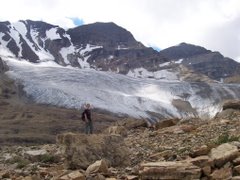
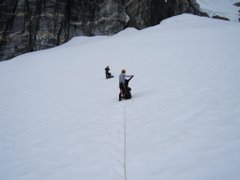
Sueño los glaciars
(I dream the glaciers)
y
(&)
el deshielo de los todos
(they all melt)
Rios desaparecan
(rivers disappear)
y
el mundo es arido
(and the world is dry)
llorando y llorando
(we cry and we cry)
Monday, April 28, 2008


Wednesday, April 23, 2008
Climate, water, and carbon...
We got the tour of the North Appalachian Experimental watershed in Coshocton, Ohio last Monday. Watersheds are monitored for the complete hydrologic cycle. Below are pictures of the H-weir (blue) that measures surface runoff and the lysimeter that weighs and calculates the infiltration of water into the ground. We were lead beneath the ground via an old concrete stairwell to view the lysimeter.


The experimental watershed is broken into various plots of different landuse, % clay, slope, and other attributes. Below are clumps of no-till soil compared with tilled soil. The no-till soil has many long burrows from worms.


This is a plastic cast of one of the burrows made in the no till soil.
Because the water cycle and landuse are monitored, we will be able to determine much about the controls on the carbon cycle in response to landuse and other conditions.


The experimental watershed is broken into various plots of different landuse, % clay, slope, and other attributes. Below are clumps of no-till soil compared with tilled soil. The no-till soil has many long burrows from worms.


This is a plastic cast of one of the burrows made in the no till soil.
Because the water cycle and landuse are monitored, we will be able to determine much about the controls on the carbon cycle in response to landuse and other conditions.
Tuesday, April 22, 2008
Incan Bones
In June, I will examine water quality in a glacial melt stream and a non-glacial melt stream that converge to feed the Rio Santos, Cordillera Blanca, Peru. Dr. Bryan Mark has already examined the oxygen isotopic signal of these streams and found that during the summer melt season ~ 40% of the Rio Santos is glacial melt. The long term hydrograph suggests these contributions shift in response to climate, I hope to understand how the water quality shifts....compounding the issue, there is a nearby gold mine that may release metals into the stream(s)....this takes my hypothesizing back to Incan times when people were forced into hard labor in mines to meet the empires growing lust for silver. Did some of the Incans allegedly killed by old world disease actually die of metal poisoning?... not just those working in the mines, but those living downstream of deadly tailings...
I just need some Incan bones...
I just need some Incan bones...
Saturday, April 19, 2008
Corn Recon and preparing for Andean Adventures
First of all, I'm heading to the cornfields on Monday to scope out my future postdoctoral project site with Climate, Water, and Carbon program Drs. Rattan Lal, Berry Lyons, and Andrea Grotolli; others will be involved but this is Monday's crew. I will take pictures.
In the meantime, I am staring at the small bruises on my arms from Hepatitis shots (I should have had those shots 10 years ago when I was waste-deep in effluent (poop water) working with the USGS; but I have so far escaped the sequence because when I was 20 I thought I would never die, and my recent exposure to poop water has been very minimal. Other good news, I still do not have tuberculosis, my TB skin test is invisible. It has been a year of exotic travel (including my first trip to Clearwater Florida; which is extremely exotic if you count the alien living at Pier 60, Trey can impersonate him too well and I am little suspicious).
I should prepare physically for working in the Andes, but unlike previous field expeditions, this time I am heading out with other folks coming from flat Columbus....to prepare for my first Antarctic trip I made sure that I could do at least 6 pull-ups. I figured this would insure I could pull a 200 pound person+pack out of a crevasse, or at least stop the fall... Now, I am concentrating on being able to build my thumb strength (training undergraduates in master pipetting (using a suped-up eye dropper to measure chemicals), and of course, my other fingers are ever-agile from dissertating and now blogging.
In the meantime, I am staring at the small bruises on my arms from Hepatitis shots (I should have had those shots 10 years ago when I was waste-deep in effluent (poop water) working with the USGS; but I have so far escaped the sequence because when I was 20 I thought I would never die, and my recent exposure to poop water has been very minimal. Other good news, I still do not have tuberculosis, my TB skin test is invisible. It has been a year of exotic travel (including my first trip to Clearwater Florida; which is extremely exotic if you count the alien living at Pier 60, Trey can impersonate him too well and I am little suspicious).
I should prepare physically for working in the Andes, but unlike previous field expeditions, this time I am heading out with other folks coming from flat Columbus....to prepare for my first Antarctic trip I made sure that I could do at least 6 pull-ups. I figured this would insure I could pull a 200 pound person+pack out of a crevasse, or at least stop the fall... Now, I am concentrating on being able to build my thumb strength (training undergraduates in master pipetting (using a suped-up eye dropper to measure chemicals), and of course, my other fingers are ever-agile from dissertating and now blogging.
Sunday, March 30, 2008
Things to Come!
Many good things have been brewing over the last few weeks. In a few short months I will be finishing my PhD after working at Byrd Polar Research Center for 5 years (not completed consecutively...) Early in the summer, I will be heading to Peru with Bryan Mark and Jeff McKenzie to examine water quality issues associated with receding glaciers. After Peru, I will come back and defend my dissertation to be knighted with my PhD.
Then... I have accepted a carbon, water, and climate postdoctoral position at Ohio State. (http://www.cwc.osu.edu). I will be collaborating with many good people at OSU examining soil, atmospheric, and groundwater-riverine carbon and nitrogen fluxes associated with agricultural and other land use types. Meeting our growing food needs with more crops will have a big impact on climate and water quality. I plan to also lead undergraduate thesis work on other 'field studies' lest I suffer a student-withdrawal drought.
Then... I have accepted a carbon, water, and climate postdoctoral position at Ohio State. (http://www.cwc.osu.edu). I will be collaborating with many good people at OSU examining soil, atmospheric, and groundwater-riverine carbon and nitrogen fluxes associated with agricultural and other land use types. Meeting our growing food needs with more crops will have a big impact on climate and water quality. I plan to also lead undergraduate thesis work on other 'field studies' lest I suffer a student-withdrawal drought.
Wednesday, March 19, 2008
Persistence
 I post this picture of what I would have worn to faculty prom had I been hired at the place that boasts its own faculty prom. Don't worry, although I'm not going to prom, I'm still wearing that wig.
I am surprised by the power of persistence. At 15, I wrote down a list of about 30 things that I wanted to do with my life including going to Antarctica and Mars. I have done most of these things, some after being rejected multiple times. The key is, knowing there are many ways to get where you set out to go.
Last week, co-led a hands-on glacier-flubber activity with gifted 8th grade girls. You could see their eyes light up as they explored how their glaciers responded to temperature, slope, and surfaces. They created their experiments, guided by their own growing interest in oozing goozing flubber. We challenged them to test their hypotheses and they did it fabulously!!!
Dr. Kathy Sullivan, was the keynote speaker for this event. Kathy was the first woman to walk in space (something I kick myself for not speaking with her about when on the way to Antarctica.) In one of her interviews she said don't let anyone "put you of your game and affect your path" Don't let anyone tell you what to do with your flubber.
Here's to enjoying the path!
Monday, March 10, 2008
Leaching Lead from Barbies?
Environmental lead pollution is so pervasive that we're (people and ecosystems) still suffering from our leaded gasoline and paint using days. Sadly, new sources of lead pollution still enter the environment via commercial products... including toys and toothbrushes. The US Senate has responded calling for greater consumer protection (NY Times 3/7/08). Will these measures be enough? And what was the delay? We've known lead in paint was bad news since the 1970s, especially for infants that crawl closer to lead-bearing soils and are prone to sticking things into their mouths...
For Environmental Geochemistry students: Take your favorite childhood toy. Stick it in a strong acid solution for a few days. Measure the lead concentration in the solution. Is your favorite toy safe? Construct an experiment to examine the timeline of lead pollution in that Barbie collection...or those Transformers...
For Environmental Geochemistry students: Take your favorite childhood toy. Stick it in a strong acid solution for a few days. Measure the lead concentration in the solution. Is your favorite toy safe? Construct an experiment to examine the timeline of lead pollution in that Barbie collection...or those Transformers...
Saturday, March 08, 2008

Wednesday, March 05, 2008
Midnight in the Valley of the Dead
Long shadows grow into darkness and the extended season in the Taylor Valley, Antarctica has begun...
Photos from the austral autumn take my mind into its joyful recesses... oh, how I am with them in spirit now!!!!
Check out the rotating pictures (at the bottom of the site) from friends staying for the extended season in Taylor Valley (this is the first time that the ecosystem will be observed "shutting down" in response to the steady loss of light.
www.mcmlter.org
Photos from the austral autumn take my mind into its joyful recesses... oh, how I am with them in spirit now!!!!
Check out the rotating pictures (at the bottom of the site) from friends staying for the extended season in Taylor Valley (this is the first time that the ecosystem will be observed "shutting down" in response to the steady loss of light.
www.mcmlter.org
Monday, March 03, 2008
Into the Water
 Last summer was the summer our dog, Loki, learned how to swim. It was the hot dripping sky that forced us all to abandon land and swim in the turbid water.
Saturday, March 01, 2008
Tooling Around
 Yesterday, I gave a talk to the home crowd on the dustiest polar glaciers on earth, the great analogues for Martian life (I'm working on my marketing skills for future endeavors). My adviser is back from his tour del tropicos so it was a good time to present. Great feedback!--- Including from Bill Showers, he stuck around for my talk... I'm still drooling over the auto-nitrate analyzer Bill uses in his studies. It will revolutionize future stream studies- best capturing pulse events (and be easy for students to use!!!). I am auctioning off my doll collection to buy one... no seriously, I will write a grant proposal for this one.
In the final stretch of PhD-land, I am building greater context for the stream chemistry story in the McMurdo Dry Valleys... although the dry valleys have been dry valleys for millions of years they are projected to respond to future global climate change... and I do have some data from the melt year to project metal fluxes with....and I do have some smart friends to collaborate with...
My coffee breath is getting to me, so I'm done tooling for now.
Friday, February 29, 2008
Fertilize the earth- the wetlands might save us...
Yesterday, I heard the most fantastic talk on nitrate! And it ties in well with a previous post this week on wetlands (the great filters and transformers of human derived pollutants). First, some background: nitrogen in our atmosphere is fixed by microbes and then utilized by all forms of life. It is an essential fertilizer. However, the burning of fossil fuels and our use of fertilizers for agricultural and other things have overwhelmed the natural nitrogen cycle. This is primarily indicated by the surplus of nitrate (for instance, in the Mount Hood Snow I collected a few summers ago, there was clearly enrichments in nitrate from fossil fuel burning). Humans presently dominate the earth's major geochemical cyles- (Vitousek and others, 1997)
Dr. Bill Showers from North Carolina State University is studying nitrate in the Neuse River Basin, NC. Bill's research group studied runoff from an area where biosolids (or the end-product of wastewater management) are applied on soils. (They know exactly how much nitrate is in these biosolids). The surprising results: groundwater, not not surface runoff, contribute most of the nitrate to the Neuse River.
Bill and his group also found that the locations where nitrate-rich biosolids were applied showed little relation to the nitrate in the stream water. The stronger control on stream chemistry was the type of soil. Water-loving soils retained the most nitrate, keeping it from reaching the streams. So, Bill and his team are going to engineer wetlands to create hydric soils and measure their capacity to retain nitrate and improve stream water quality......
The biggest, scariest conclusion of Bill's talk was that by 2050 fertilizer, sludge, wastewater, and even groundwater are going to pale in comparison to atmospheric nitrate flux. This is very, very bad for us with the nitrate concentrations in many watersheds already reaching toxic levels (think- blue baby syndrome).
Dr. Bill Showers from North Carolina State University is studying nitrate in the Neuse River Basin, NC. Bill's research group studied runoff from an area where biosolids (or the end-product of wastewater management) are applied on soils. (They know exactly how much nitrate is in these biosolids). The surprising results: groundwater, not not surface runoff, contribute most of the nitrate to the Neuse River.
Bill and his group also found that the locations where nitrate-rich biosolids were applied showed little relation to the nitrate in the stream water. The stronger control on stream chemistry was the type of soil. Water-loving soils retained the most nitrate, keeping it from reaching the streams. So, Bill and his team are going to engineer wetlands to create hydric soils and measure their capacity to retain nitrate and improve stream water quality......
The biggest, scariest conclusion of Bill's talk was that by 2050 fertilizer, sludge, wastewater, and even groundwater are going to pale in comparison to atmospheric nitrate flux. This is very, very bad for us with the nitrate concentrations in many watersheds already reaching toxic levels (think- blue baby syndrome).
Subscribe to:
Comments (Atom)