Friday, January 02, 2009

Freeze-thaw-freeze


Carla and I have been sampling several times now. Each time, my fingers are becoming more solid as the air temperatures drop. To prevent the loss of sensation in my fingers, I put on layer after layer of clothing, which makes me fumble with the bottles more. Fortunately, Carla is much more dexterous than me.

We have also analyzed many of the samples we collected as well as some from storm events that the USDA collected for us. Most of all, I'm happy that we were able to get the pvc soil collars into the ground last week before the ground became to solid to pound them into the ground. Now, we are ready to use the Licor to measure the breath of the earth, or the carbon dioxide emitted from the different land use types. I marked our locations with flags... it seems that we are overdue for a big Ohio snowfall. However, I suspect we may have a good snow free day in January to make our first measurements.

Tuesday, December 16, 2008

Meeting and Mingling

I'm at an International meeting in San Francisco with other earth scientists... the turnout is amazing. We overfill the escalators and spill out of the lecture halls. There is no shortage of meaningful & inspiring discussions. Also, because the meeting is broad in scope, I've run into friends and mentors from times past. Admittedly, I am exhausted now, but can't wait to do it again tomorrow.

Monday, November 24, 2008

Proposaling: dreaming or reality?


A few people have asked, where does the money to do earth science come from? If you have good hypotheses- that are important beyond your immediate peers, and propose tests that will support those hypotheses... sometimes, the government will give you money... there are also other ways, private sponsorship, lottery winnings (similar to being a student on a really cool funded project) but in the Byrd Polar Research Center and other research centers across the USA proposals are written to the National Science Foundation.

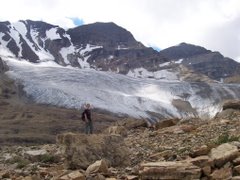
I submitted one with Bryan and Jeff and attempt to answer some questions from our previous work in Peru. Why? Most tropical glacier melt is routed through wetlands where potentially toxic metals are rapidly added to streams... people are reliant on this water, water quantity is rapidly changing as glaciers recede. Will issues with water quality precede water quantity issues? Will these issues be worse in the dry season with more variable stream flow? (stream flow is buffered by glacial inputs). At any rate, the water is blood red now (above).... Will it turn neon upon the death of tropical glaciers? Also, think of all the cool things to do with students.

Michael and Carla are already calculating dry season weathering rates- but the wet season is unknown...

Tuesday, November 18, 2008

Snow in the fields


Carla and I went out to Coshocton fora round of sampling and a holiday meal with the USDA folks. Martin shared his travel adventures examining soil erosion/management issues in sourthern India after our feast. Above are some pictures of this first snowy mission. Carla has a knack for sampling! In addition to this cow, we came across a mink and two bucks! It was a beautiful sunny day to sample.

Monday, November 10, 2008

Percolation


I am not measuring metals in cornfield groundwater...

Thursday, November 06, 2008

Pictures

Martin from the USDA emailed a few more pictures from our last sampling trip. The next trip is in just less than 2 weeks. Carla, an Earth Sciences undergrad, is going to come out with me to sample and set up the Licor (measures CO2 respiration from the soil). She will be completing her undergraduate thesis working with me (Thanks Berry!). She'll examine alkalinity (or the inorganic carbon flux) associated with different landuse types we are examining: forested, corn till, corn no till, mixed, and unimproved pasture. She is also planning to compare this with samples gathered from Peru this summer. It should be an interesting study because both glacial and agricultural watersheds have high erosion rates.


Tuesday, November 04, 2008

Thank you

Here's a picture of my dissertation defense committee: Anne Carey, Berry Lyons, me, Bryan Mark, and Lonnie Thompson. It was a good road to my PhD with their input and support. (And the support of Andrew Fountain who served on my dissertation committee). Recently, I had the chance to thank my adviser, Berry, for making my Antarctic dream possible. As I move forward leading my own research endeavors, I hope that I am able to give back as much as I have received. I could not have had better role models.

Sunday, October 26, 2008

Adventures in Tilth


While at a recent conference (GSA-SSSA), I learned a new word: tilth. Tilth is all aspects of soil that relate to its fertility and productivity. Understanding tilth, includes examining the storage and loss of essential elements.

This weekend we dedicated ourselves to tilthly knowledge.

Pictured tilth crew activities: 1) Jen, volunteering from Metro High School (she's also been working on some data from Peru); 2) the mixed landuse field plot and the white groundwater monitoring building); 3) Klaus, Ilan, and Jen; and 4) Jen showing off her foot after retrieving her shoe from mud and Martin smiling at our muddy feet.

Thursday, October 16, 2008

Carbon in Cornfields: all altitudes and latitudes considered

Well, the bottles are all lined up in a row for next weekend. A high school student and an undergraduate (now anonymous, but not for long) will be joining me heading out to Coshocton in the quest to understand the link between agricultural practices and the storage and loss of carbon from soil. But, I can't help but think of the cornfields high in the Andes, hanging from the sides of mountains. I'm looking at this landscape wondering how many hours of manually tilling and toiling would be needed to grow an acre of corn? And what is the rapid increase of temperatures at high altitudes and human industrial spewing of nitrate doing to those fields now.....???

Wednesday, October 01, 2008

Welch Crag

Yesterday my good friend, Kathy Welch, learned she had a crag named after her! (After she won a service award at Byrd Polar Research Center).

Welch Crag: 77°17'08"S Latitude, 160°36'37"E Longitude. A steep rugged peak, which is marked by secondary spires rising to 1500 m in the north-east part of McSaveney Spur, Willett Range, Victoria Land. Topographic Map: Webb Lake (1:50,000).

Here's to Kathy! She'll be blogging from the Antarctic soon in her 16th field season!

Saturday, September 27, 2008

Till, no till, here we come!

Monday, I went out to the field with Andrea Grottoli so that we could get on the same page with our sampling effort. We're both transferring skills from different research arenas (glacier melt- me, and coral chemistry- Andrea) to understanding carbon storage in the pastures and cornfields of central Ohio. Andrea is very pregnant and wanted to make sure that her research tech/postdoc, Yohei new where to sample come mid-October.

The Peruvian side project is going well, I'm drafting a paper on the craziest metal concentrations ever observed in glacial melt .... and will get the draft and remaining data to Jeff and crew by the end of the year. The success of the Peruvian project is mostly due to the efforts of 2 undergraduates and now, 1 high school student (They are so good!!!!)

Tuesday, September 16, 2008

Update from the office

Hey all! OSU is on its own power grid, but large chunks of Columbus are still without power after Hannah and Ike made their way inland. Our trees are rather spindlely and we may have to push back a few fun cookouts to deal with the remnant limbs strewn across the yard. We are lucky to not have had further damage and wish those of you who are dealing with worse the best (especially those closer to the coast).

On the science front, I'll be heading to the December American Geophysical Union meeting to present some of the results from Peru (phew good data!). The water was as wacky as predicted... but plenty of data sorting and interpretation remains! The preliminary results are very exciting, this was not temperate glacial melt....

Also, next week is one more recon mission to the Coshocton Cornfields before the real deal begins. The fields should be glorious this time of year!