Monday, June 09, 2008

Map of the future


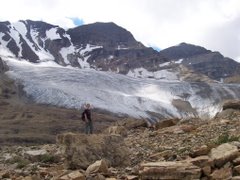
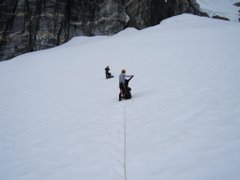
Here's where we're heading...

Saturday, June 07, 2008

Frozen Weir to beat the heat


The humidity, a pack of hungry dogs licking my face, arms, and legs... to slow the swelter I visualize this... (oh, glorious frozen stream!)

In less than 2 weeks I will be in colder Andean temperatures!

Tuesday, June 03, 2008

Monday, May 26, 2008

Big Darby and future high altitude streams

Catherine and Gregg just completed two amazing poster sessions displaying there work on the Big Darby River, Ohio and Panamanian weathering. (I took the below pic of Berry sampling Catherine's site).

I'm already counting on eating blocks of cheese (or another high fat Peruvian food) in an alternating sequence with chocolate to deal with high altitude headaches and hunger. I suppose aspirin and some time away from the computer will also help. I also just realized that the bus from Lima to Huaraz is an 8 hour segment. I'll keep the end in mind. Jeff sent some amazing pics his brother took on their last visit!

Thursday, May 15, 2008

If I lived on Europa

If I lived on Europa perhaps I'd be a microorganism eating heavy metals in the veins of glacier melt... The ponded liquid would retain dissolved metal solutes, the gatorade for my energy needs. Cryoholes and ponds are the fertile wetlands of glaciers on Earth and on other icy worlds.

Here's one from Europa on earth, my first trip south... Andrew, Martyn, Berry are in the top row, Heather, Virginia and me are kneeling.

Sunday, May 11, 2008

Loess Microderm Abrasion

Dissertating on Sunday is no good. I am already distracted by thoughts of sitting on the margin of the Llewellyn Glacier scooping a big paw of loess into my hands, burrowing in the soft silky grains and smearing it on my face. Look at the latest microderm abrasion products available, many of them feature 'aluminosilicates' which find their equal mate in glacier loess...

Also, to clean this loess off my face, there is the magic of used tea bags...

Wednesday, May 07, 2008

Planning for the pre-dissertation sabbatical

I met with Dr. Bryan Mark to discuss plans for traveling into the Andes. I will be flying into Lima on June 20th and meeting others from McGill University. Then after 2 field weeks (or 22 days) I will return with bags of water to analyze and breath-taking views to digest. All of this pre-dissertation sabbatical planning is going well and the bottles are piling up for a massive assessment of Andean water quality. I am also finalizing the last paper in my dissertation (unless I write a fourth...). Anyway, I am geeked out and my brain is already at high altitude... this is mostly because I saw a picture of the rise of the Cordillera Negra and the Cordillera Blanca that bisect Peru... in the middle of these two ranges is the valley we will be researching. The valley floor is at 11,300 ft. or well above the elevation of the famed Machu Picchu one of the last great Incan cities.

Monday, April 28, 2008

El deshielo de los todos glaciars de los montañas

Sueño los glaciars
(I dream the glaciers)
y
(&)
el deshielo de los todos
(they all melt)
Rios desaparecan
(rivers disappear)
y
el mundo es arido
(and the world is dry)
llorando y llorando
(we cry and we cry)

Wednesday, April 23, 2008

Climate, water, and carbon...

We got the tour of the North Appalachian Experimental watershed in Coshocton, Ohio last Monday. Watersheds are monitored for the complete hydrologic cycle. Below are pictures of the H-weir (blue) that measures surface runoff and the lysimeter that weighs and calculates the infiltration of water into the ground. We were lead beneath the ground via an old concrete stairwell to view the lysimeter.


The experimental watershed is broken into various plots of different landuse, % clay, slope, and other attributes. Below are clumps of no-till soil compared with tilled soil. The no-till soil has many long burrows from worms.


This is a plastic cast of one of the burrows made in the no till soil.


Because the water cycle and landuse are monitored, we will be able to determine much about the controls on the carbon cycle in response to landuse and other conditions.

Tuesday, April 22, 2008

Incan Bones

In June, I will examine water quality in a glacial melt stream and a non-glacial melt stream that converge to feed the Rio Santos, Cordillera Blanca, Peru. Dr. Bryan Mark has already examined the oxygen isotopic signal of these streams and found that during the summer melt season ~ 40% of the Rio Santos is glacial melt. The long term hydrograph suggests these contributions shift in response to climate, I hope to understand how the water quality shifts....compounding the issue, there is a nearby gold mine that may release metals into the stream(s)....this takes my hypothesizing back to Incan times when people were forced into hard labor in mines to meet the empires growing lust for silver. Did some of the Incans allegedly killed by old world disease actually die of metal poisoning?... not just those working in the mines, but those living downstream of deadly tailings...

I just need some Incan bones...

Saturday, April 19, 2008

Corn Recon and preparing for Andean Adventures

First of all, I'm heading to the cornfields on Monday to scope out my future postdoctoral project site with Climate, Water, and Carbon program Drs. Rattan Lal, Berry Lyons, and Andrea Grotolli; others will be involved but this is Monday's crew. I will take pictures.

In the meantime, I am staring at the small bruises on my arms from Hepatitis shots (I should have had those shots 10 years ago when I was waste-deep in effluent (poop water) working with the USGS; but I have so far escaped the sequence because when I was 20 I thought I would never die, and my recent exposure to poop water has been very minimal. Other good news, I still do not have tuberculosis, my TB skin test is invisible. It has been a year of exotic travel (including my first trip to Clearwater Florida; which is extremely exotic if you count the alien living at Pier 60, Trey can impersonate him too well and I am little suspicious).

I should prepare physically for working in the Andes, but unlike previous field expeditions, this time I am heading out with other folks coming from flat Columbus....to prepare for my first Antarctic trip I made sure that I could do at least 6 pull-ups. I figured this would insure I could pull a 200 pound person+pack out of a crevasse, or at least stop the fall... Now, I am concentrating on being able to build my thumb strength (training undergraduates in master pipetting (using a suped-up eye dropper to measure chemicals), and of course, my other fingers are ever-agile from dissertating and now blogging.