Friday, July 11, 2008

I still haven't eaten a guinea pig

Yesterday we got special permission to head to Pasto Ruri, a National Park that has been shut down for a variety of political reasons. There, you used to be able to ski down the glaciers, but now, there is little to shoosh down.

Anyway, I am very tired and my nose is nearly touching the keypad. In the last 5 days I have hiked over 8 hours a day on average and I am eating everything in site. (Altitude has not diminished my appetite. We have yet to venture into restaurants serving guinea pigs yet, so I am still limited in my culinary adventures). Pictured is Sarah Wright, who will stay after most of us leave to conduct a tourism study for her Master's Thesis. She helped me sample yesterday and is very upbeat even under strenuous conditions. Also pictured are Adam, Paul, Allyson, and Kyung who are the Lidar/GIS/GPS/Survey team on this mission. (Behind them is the shrinking Pasto Ruri). The last pictures are from today, Jeff, Sara Knox and I woke up at 5 and headed back to Llanganuco to sample tributaries from two headwater lakes.

I'll write more tomorrow about what we're doing... after I hydrate and eat a few plates of food.


Wednesday, July 09, 2008

Indecent Exposure


I'm working on rehydrating after a few full days of hiking, climbing, and sampling in Quilcayhuanca. We're inside the California Cafe having second breakfast. The main entrance mostly blocked by a metal garage door to prevent stray rocks from pummeling us. (Most strikers are not violent, but some are, and they throw things). Sarah Wright (see Peace and Skittles Link) had to duck (or rather, was pushed to the floor by the guy she was interviewing at the Statistics
Office yesterday). Many businesses are still open, but in a covert steel covered sense. The fresh "communista" graffiti and eerily quiet streets. (It is usually bustling at all hours).

Here's a picture of me on our hike down from Yanamarey Glacier- my zipper broke and the duck tape solution finally blew out. It is pretty indecent for Peru, so I put on my pair of Granny pile pants by the time we caught our cab out.

Uhhh- the steel door was just pulled all of the way down because a flock of strikers are walking by. My latte sure is good....

Quilcayhuanca!!!


yikes! In a tired worry, I attempted to save some of my pics to an external hard drive and deleted about 100 of my faves..lost somewhere between the hard drive and the altitude. (unfortunately many of these were of people. Staggering mountain views are great, but the crew here is amazing!). Here a few that I didn't delete from the Quilcayhuanca Valley. The first is me (with a polvo beard) at more than 5000 m. Jeff Bury, Adam French and I woke up at 4 am to get that high and made it back to camp at dusk... I also managed to get a headwater sample!) The last picture of Bryan Mark is one of a handful of people pics that survived my tired erasing.

Friday, July 04, 2008

Thursday, July 03, 2008

Overwhelming Beauty


We sampled the Llanganuco chain of lakes. Jeff, Sara, Jesus and Adam also mastered the art of weather station maintenance and upgrading. The views in Huascaran National park were overwhelming. As the polvo (dust) fell from our faces, the mountains towered from all sides. Surrounding us included Pisco and Huascaran (the same mountain cull Lonnie Thompson and crew drilled for 64 days).

Pictured are one of our sampling sites, Jesus and Adam successfully replacing the memory on one of the weather stations (after a two hour gazelle run up landslide debris), Huascaran, and two views of and from the met station.

Also a new crew from Nova Scotia arrived that are helping Bryan with Lidar flights above the Cordillera Blanca. It looks like the flights on hold may soon take off, which we all hope for.

Monday, June 30, 2008

Yanamarey Glacier & Pampas


We reached 4800 meters! Jeff McKenzie, Sara Knox, Jeff Bury, and Adam French and I hiked in two groups up to the hut near the terminus of the Yanamarey Glacier. Jeff M., Sara, and I sampled water in the pampa lowlands on the way up. These mushy grasslands are great sponges. The pampas filter and store much of the highly mineralized water that courses directly in front of the glacier. They likely serve the same role as wetlands do at higher latitudes.

As Jeff M., Sara, and I sampled, Jeff B. and Adam loaded our extra gear onto two hired horses. The local man who lead these horses was one of the worst they had ever hired in their multiple trips up this valley. (Starting with not having rope to tie our gear to the horses).

Just before dusk we reached the tin and stone hut at the base of the Yanamarey. In spite of my past 3 days of less than perfect health, I felt well enough to be on dinner and tea crew and Adam and I made a big pot of potato stew. Soon after eating we all slept in a tight row and I made sure to avoid flailing my arms and legs around to stretch them out.

I am glad that I felt well at night, because the morning was more difficult and required some mental readiness and a few Advil. The altitude was slower paced and breathier than lower elevations. I'm sure that my sample bottles from these heights have wiggly writing born from my new strange body. But the views were worth every bit of this surreal experience.

Friday, June 27, 2008

A day for no pictures

Today is my second rest day, and I'm now taking Ciprofloxacin a strong antibotic that after two doses seems to be doing the trick. I feel well enough to work, yet, I stayed behind. We are heading to higher altitude tomorrow at the Yanamarey Glacier for an overnight and I think taking care of myself is the best preparation. The others are out installing water monitoring equipment and talking to nearby communities.
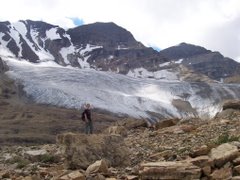
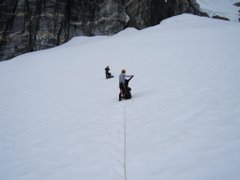
I am thinking of the stinging frothy red water we sampled from a llaves pile (mine tailings) before it entered the river. Most devastating, the barren dust-field stretched out in front of it was marked by children's footprints. A flock of uniformed kids dutifully bounced to school across this parched poisonous land. The source of a pervasive local cough is likely the pumping of this flour into the air. This day was a mix of emotions with the kids burned into my head sharply contrasting with images from the Andean headwaters we sampled earlier. Before the alpine glare of the afternoon, golden grasses spanned out across the broad flat valley towered by glistening rise of the ice covered Cordillera Blanca. I am humbled by both grandeur and devastation.

Thursday, June 26, 2008

Wednesday, June 25, 2008

Vive Saltines!


Today was beautiful. I think the penalty for seeing such beauty may be some digestive revenge. Thank goodness for flat rocks, hand sanitizer, and a healthy obsession with carrying many liters of water. (Samples not included). Here is one photos from the day (uploading is slow now). Jeff Bury, from UC Santa Cruz joined us today. He is a social geographer with memorized knowledge of the mining history of the Rio Santa Valley, and is one of the principle grantees on this study. I'll leave the pictures of mine tailings for another day!

Tuesday, June 24, 2008

Beautiful streams

It is the dry season. But there is ample rain in the Rio Santa Valley. Jeff, Sara, and I started out pushing Teo's car down the street to jump start it and we were off on our Dry Season 2008 tour de hydrogeochemistry. I am only showing pictures of the natural glory of our sampling trip and avoiding the human picture. The Rio Santa and its tributaries are a water source for washing clothes and funneling waste of the city. The lumps of human hair mingled with animal bones were among the easier things to look at.

The people we've met in town have been very friendly and helpful. Willing to translate my gesture-rich travel Spanish with genuine smiles.

Monday, June 23, 2008

Huaraz and Yungay


Today and yesterday have been busy, running around acquiring supplies. Including a 60 dollar cooler. Jacquie Smith, a professor at the College of Saint Rose in New York has been very helpful with her experience navigating in Huaraz, alone I'd be much like one of the headless animals we see hanging from the market racks. Her group (Kerry and Nate), and Kyung from OSU are heading out into the field tomorrow.

Jeff, Michel, and Sara and I will travel to our first stream sampling sites tomorrow.

Photos are of a parade through Huaraz, Bryan describing the tragic 1970 avalanche at Yungay (~18 thousand died), the vegetation that grew over the destroyed city, and a survivor of the Yungay avalanche.

Sunday, June 22, 2008

Road to Huaraz


Our herd of ten boarded the bus after nudging our packs to the weighing scales as lithely as possible. It was a clumsy process, but as efficient considering the size of the aisles and the bulk of our gear. The bus provided much needed cushioning to recover from our late night traveling. It was much nicer than the typical Greyhound, equipped with lounger legs and built in neck cushioning. The road to Huaraz was enjoyable.

The ride was one of stark landscapes the arid dune fields, the parched foothills of the Andes. Like the arid west, there were many dryland farms with extensive irrigation. Most of the ascent was through these gradual sandy expanses, and we spent much less time on windy mountain roads than I anticipated. It was pitch black for most of that part of our ride.

After arriving at Bryan's home away from home (Mi Casa) we had a nice meal of semolina and chicken soup, chicken, potatoes and rice. Unfortunately, a few toasts and the high altitude didn't agree with me well last night, but I feel refreshed today and ready to explore Huaraz. We will spend the day acclimating before starting our field work.

It was a treat to see the welcoming smiles of the Mi Casa family. It reminded me of returning to Lake Hoare where old friend reunite. It is nice to few this from the outside and truly appreciate the field experiences I have had.